
The $5.2 Million Miscalculation: When a Damages Expert's Errors Weren't Enough to Keep Him Off the Stand
A retirement plan expert survived a Daubert challenge despite share class confusion, unverified data, and excluding revenue sharing from his model.

An expert witness submitted a damages model to a federal Court — a model built on data he did not personally collect, verified against a free version of a research platform that could not access the historical figures he needed, and structured around a share class comparison that turned out to rest on a naming error. The opposing side argued that more than three-quarters of his data points were wrong. Their own expert re-ran his methodology and arrived at a number that was not just lower — it was negative.
And the Court let him testify anyway.
This case offers a window into a question that matters to every expert who builds a damages model, prepares an opinion on fiduciary standards, or testifies about investment decision-making: how much can go wrong in an expert report before a Court decides the problems are fatal? The answer, at least in this case, turned out to be quite a lot — provided the underlying methodology is sound, the errors can be isolated, and the challenge is really about the merits of the case rather than the reliability of the method.
Here is what happened.

A Billion-Dollar Plan and a Fee Dispute
The case began in early 2020, when former employees of a large technology company filed a class action lawsuit in federal Court. They alleged that the company, its board of directors, and a three-member investment advisory committee had breached their fiduciary duties under ERISA — the Employee Retirement Income Security Act — in managing the company’s 401(k) retirement plan.
The plan was substantial. According to the complaint, it held over a billion dollars in assets by 2016 and crossed the two-billion-dollar mark by the end of 2018. It had more than 25,000 participants with account balances. The Plaintiffs argued that a plan of this size had significant bargaining power in the marketplace — and that the fiduciaries responsible for it had failed to use that leverage.
The complaint centered on fees. As of December 2018, the plan offered twenty-seven investment options, all mutual funds. Nearly eighty percent of its core investments were actively managed. The Plaintiffs argued that almost half of those investments were significantly more expensive than comparable options in similarly sized plans.
The target date fund suite, for instance, carried expense ratios ranging from 0.61% to 0.72%. The Plaintiffs alleged that the median for comparable plans was 0.56%. One domestic equity fund carried an expense ratio the Plaintiffs said was roughly 135% above the median for its category.
But the sharper allegation involved share classes. The Plaintiffs argued that for many of the plan’s mutual funds, cheaper share classes of the exact same fund were readily available. The plan’s institutional shares were between 17% and 48% more expensive than available lower-cost alternatives within the same fund family, according to the complaint. The Plaintiffs argued that one large equity fund’s institutional share class, with an expense ratio of 0.73%, carried what they characterized as a 70% fee excess over a commingled pool version of the same strategy, which was available at 0.43%.
The Plaintiffs also argued the plan should have considered collective investment trusts and separate accounts — vehicles the plan’s own investment policy expressly authorized — instead of sticking exclusively with mutual funds. And they contended the plan’s heavy reliance on actively managed funds was itself imprudent, given research suggesting that actively managed funds rarely outperform passive alternatives over longer horizons after accounting for fees.
The complaint acknowledged that the plan made significant changes to its investment lineup in 2019, five years into the proposed class period. Some funds were converted to lower-cost share classes. But the Plaintiffs argued these changes came too late. The damages, they contended, had already accumulated.
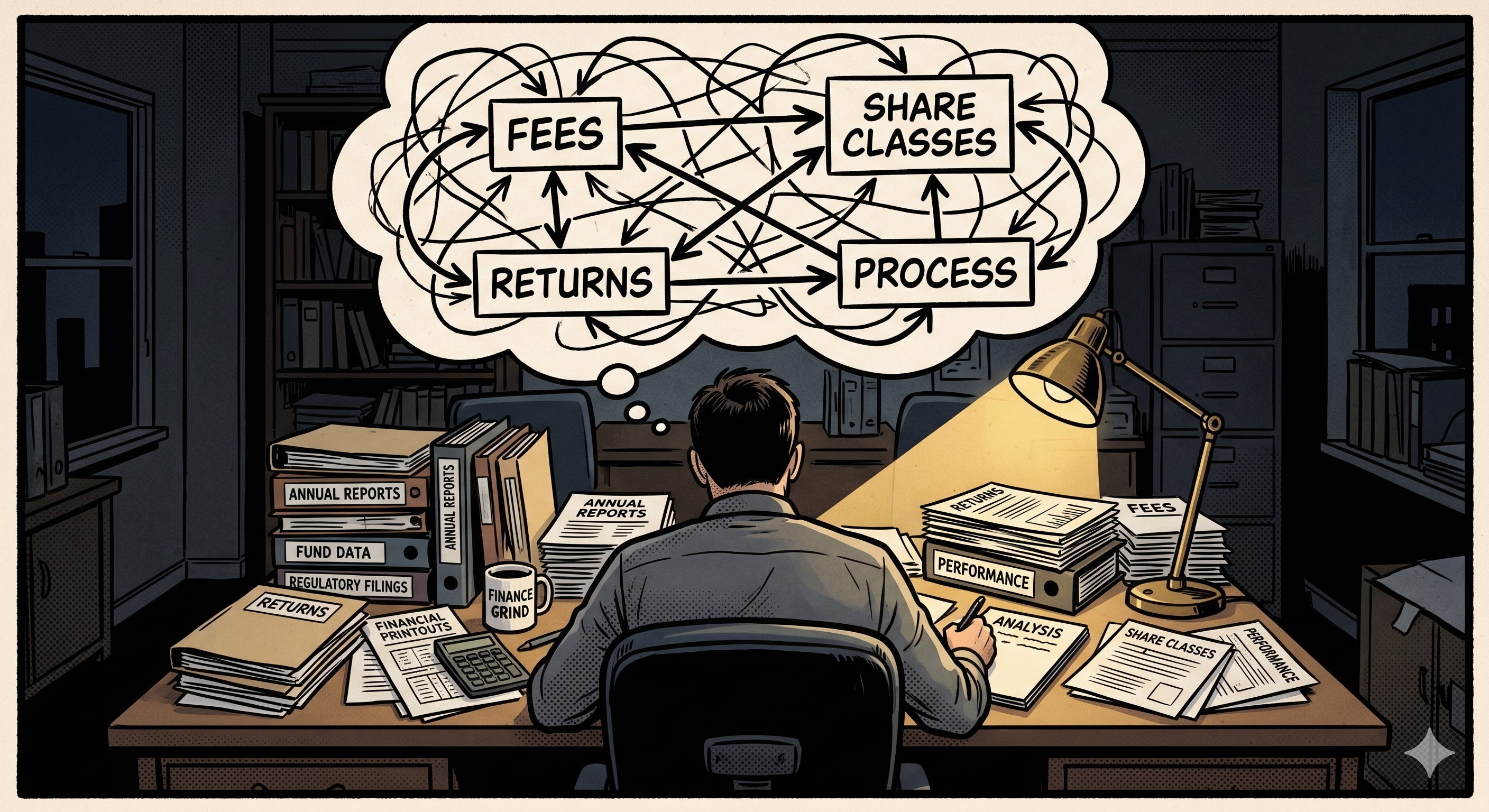
The Expert and His Assignment
By late 2023, the case had progressed to the point where expert testimony would matter. The Plaintiffs’ expert was a securities industry veteran with forty-six years of experience. He held an M.B.A. in Finance and had co-founded two expert witness firms specializing in investment disputes and industry standards. His career included managing discretionary accounts and providing research and transactional coverage for non-discretionary accounts, including pension plans, from 1977 to 1980, and managing equity portfolios for pension accounts as a portfolio manager from 1983 to 1998. Since 1998, he had worked exclusively in litigation support.
He was engaged to opine on two things: whether the plan’s fiduciaries followed a process consistent with the standard of care of a prudent fiduciary, and what losses the plan’s participants incurred as a result.
His conclusions were pointed. He opined that the committee had failed to adhere to a fiduciary standard of care — not through any single act, but through what he described as an aggregate of failures in decision-making, monitoring, and cost management. He argued the plan held funds with unnecessarily expensive fees when lower-cost share classes of the same investments were available. He calculated approximately $5.2 million in share class damages.
He also opined on the committee’s process more broadly. He argued the committee had a pattern of deferring to its outside investment advisor without engaging in critical review of its own. He questioned whether the committee members had the investment expertise necessary to exercise independent judgment. And he argued the plan’s investment policy statement, while typical of the industry, set mediocrity as the benchmark rather than serving the best interests of participants.

The Motion to Exclude
In November 2023, the Defendants filed a motion to exclude the expert’s testimony under Rule 702 and the Daubert standard. The motion attacked on four fronts: qualifications, relevance, methodology, and data accuracy.
Paid subscribers get access to Court records such as Complaint, Expert Reports, Deposition Transcripts, Motions to Exclude and Court Orders, where available. To access the full case study and the original Court filed documents in this case, consider upgrading to Paid subscriber.
